

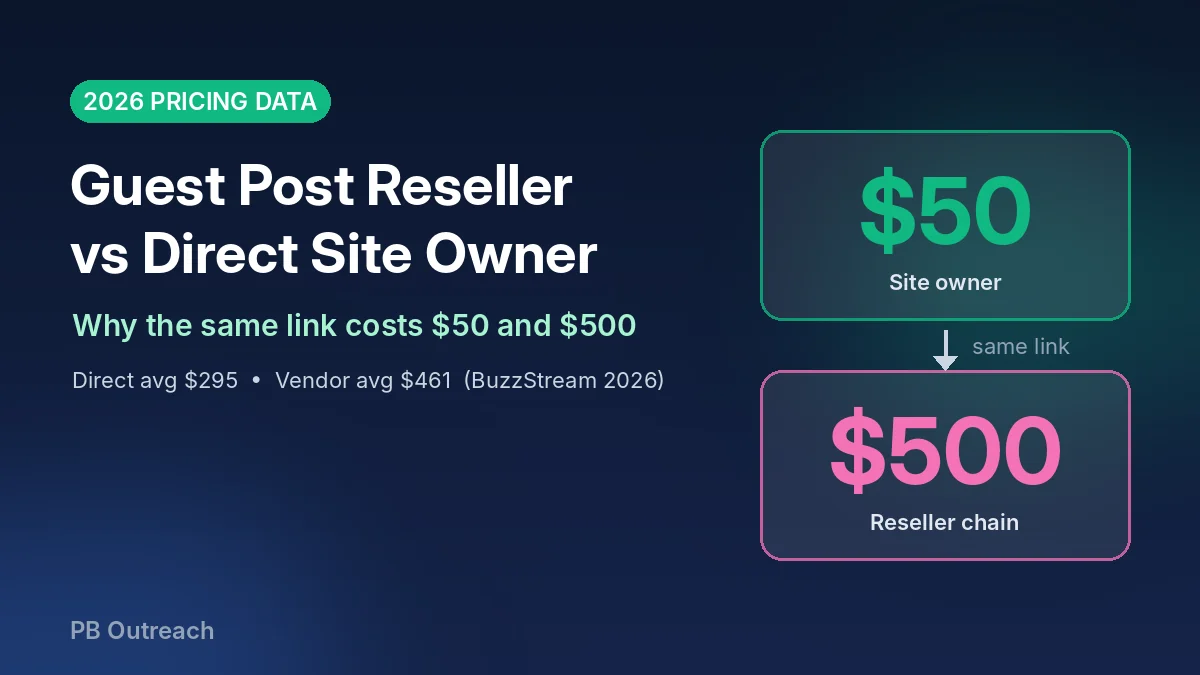
Two sellers offer you a guest post on the same website. One quotes $50, the other quotes $500. Same domain, same link, ten times the price.
This is not a scam in most cases. It is a supply chain. This guide explains the guest post reseller vs direct site owner difference, where the extra money goes, and when paying more is actually worth it.
Quick Answer: The same guest post can cost $50 or $500 because every reseller between you and the site owner adds a markup. BuzzStream's 2026 study of 257,267 sites found guest posts average $295 bought directly versus $461 through vendors. Agencies that add writing, vetting and reporting charge more again, so prices stack quickly.
Who this guide is for: SEO freelancers, agencies and business owners worldwide who buy guest posts. All prices are in US dollars, because almost all guest post sellers quote in USD, including sellers in Pakistan, India and Bangladesh. UK buyers will often see prices in GBP on UK marketplaces, but the markup pattern is the same everywhere.
Where the Extra $450 Goes: The Guest Post Supply Chain
A guest post link rarely travels straight from the site owner to you. It usually passes through two to four hands, and each one takes a cut.
Here is a typical chain. The numbers are an illustration of how markups stack, not prices from one specific site.
| Who sells it | Price you would pay | What they add |
|---|---|---|
| Site owner (direct) | $50 | Publishes the post |
| First reseller (outreach seller) | $80–$100 | Owns the contact, adds 30–100% |
| Marketplace or second reseller | $150–$250 | Listing, payment protection, platform fee |
| White-label agency | $350–$500+ | Content writing, reporting, account management, its own margin |
Reseller guides openly describe this model. Some white-label resellers charge a flat 30–50% over their own cost, while others bundle guest posts into bigger SEO packages where the single post price is hidden.
What the 2026 Pricing Data Shows
You do not have to rely on stories. Two large 2026 studies measured the gap between direct and resold prices.
- BuzzStream (updated June 2026): After cleaning almost 500,000 listings down to 257,267 sites with full data, guest posts averaged $295 direct and $461 through a vendor. That is about 56% more for the same type of placement.
- BuzzStream's earlier study (2025): Across 26,000+ sites, the average direct price was $365, but the average price through a vendor that handled everything was $1,459.
- Adsy (February 2026): Across 52,671 websites, the average guest post cost $459, up 7.5% from $427 the year before.
- Adsy (2025 report, 37,542 websites): Asking prices and real deals were far apart. DR 41–50 sites listed posts at $406 on average, but buyers actually paid about $59. That gap is the $50 vs $500 problem in one number.
BuzzStream used the lowest vendor price it could find as the "direct" price and noted that some markup is still baked in. So the real direct-to-reseller gap is likely larger than the averages suggest.
2026 Guest Post Prices by Buying Route
| Buying route | Typical 2026 price | Writing included? | Best for |
|---|---|---|---|
| Direct from site owner | $295 average (BuzzStream) | Usually no | Buyers who can vet sites and write content |
| Reseller or vendor | $461 average (BuzzStream) | Sometimes | Buyers who want a ready list and one point of contact |
| Marketplace listing | $459 average (Adsy) | Optional, extra fee | Buyers who want payment protection and filters |
| Full-service agency | Up to $1,459 average (BuzzStream 2025) | Yes | Brands that want hands-off link building with reporting |
Guest Post Reseller vs Direct Site Owner: Side by Side
Price is only one part of the decision. Here is how the two routes compare on the things that matter after you pay.
| Factor | Direct site owner | Reseller / middleman |
|---|---|---|
| Price | Lowest | 30% to several times higher |
| Finding sites | You do the research | Ready-made list |
| Site vetting | Your job | Varies from strong to none |
| Content writing | Usually your job | Often included or offered |
| Edits after publishing | Ask the owner directly | Requests pass through every layer |
| If the link is removed | Deal with the owner | Depends on the reseller's replacement policy |
| Number of invoices | One per site | One for many sites |
Why Guest Posts Are So Expensive, Even Without a Middleman
Markups explain the gap between sellers. They do not explain why some direct prices are already high. Site quality does that.
- Authority: Adsy's 2025 report on 37,542 websites showed average asking prices of about $351 for DR 11–20 sites, $462 for DR 41–50 and $1,008 for DR 71–80.
- Niche: The same 2025 Adsy report found web development sites averaged $1,096 per post, while personal blogs averaged $323.
- Real traffic: BuzzStream found 96.2% of guest post sites rated Low Quality and 39.6% with zero monthly organic traffic. Sites with real traffic are rare, so they charge more.
- Editorial standards: Sites that edit, reject weak content and publish few sponsored posts take more work and charge accordingly.
So a $500 price is not always a markup. Sometimes it is a good site charging a fair rate. The skill is knowing which one you are looking at.
Also read: Forget DR & DA? Why AI Visibility Wins Now (2026)
When a Reseller Is Worth the Markup
A middleman is not automatically bad. You are paying for time and risk, and sometimes that trade is worth it.
- You need volume fast: Contacting 50 site owners one by one can take weeks. A reseller with a vetted list can deliver in days.
- You need content written: Many site owners only publish. A reseller that writes good, niche-relevant articles saves you a second hire.
- You want replacement guarantees: Good resellers replace links that disappear. Most individual site owners do not offer this.
- You are an agency: White-label services let you sell link building under your own brand without building an outreach team.
The markup becomes a problem when the reseller adds no value. That means no vetting, no writing and no support, just a spreadsheet with higher prices.
How to Buy Guest Posts Directly from Site Owners
If you have time and want the lowest price, buying direct is a simple process. Here is a six-step method.
Step 1: Build a Shortlist of Relevant Sites
Search Google for your niche plus phrases like "write for us" or "contribute". Pick sites that actually cover your topic, not general sites that publish everything.
Step 2: Check Real Traffic
Use an SEO tool to see organic traffic and whether it is stable or falling. A site with high authority but almost no traffic is a red flag.
Step 3: Find the Real Owner's Contact
Look for an email on the site's own domain, such as editor@sitename.com, on the contact or write-for-us page. Free email addresses that offer dozens of sites are often resellers.
Step 4: Ask for the Price and the Rules
Ask for the price, whether the link is permanent, how the link will be marked, and whether they allow edits later. Get the answers in writing.
Step 5: Compare Quotes
Search marketplaces for the same domain. If several sellers list it, the lowest price is usually closest to the owner's rate.
Step 6: Pay Safely and Check the Live Post
Use a payment method with buyer protection for first orders. After publishing, check the link, the anchor and whether the page is indexed.
Also read: How to Spot a Fake Guest Posting Site Before You Pay (2026)
How to Spot a Guest Post Middleman
Resellers often present themselves as site owners. These signs suggest you are not talking to the real owner.
- A huge site list from one free email: One person rarely owns 200 unrelated news and lifestyle sites.
- Slow answers on simple questions: If they need a day to confirm a word count, they are probably asking someone else.
- No edits after publishing: The seller cannot change the post because they cannot log in to the site.
- The same domain at different prices: Search the domain on two or three marketplaces. Different prices mean different resellers.
- "Lifetime" or "permanent" promises with no policy: Only the owner can keep a link live. A reseller can only promise to replace it.
What Google's Rules Say About Paid Guest Posts
Whoever you buy from, the link carries the same risk. Google's spam policies list buying or selling links for ranking purposes, including paying for posts that contain links, as link spam.
Google allows paid links when they are marked with the rel="sponsored" or rel="nofollow" attribute. Its policies also name keyword-rich anchor text in guest posts as a problem. Buying direct does not make an unmarked paid link safe, and neither does buying through a reseller.
Also read: Why Is My Website Deindexed? Causes & Proven Fixes
How We Checked This Guide
Prices come from BuzzStream's guest post cost study (257,267 sites, updated June 2026), BuzzStream's 2025 study, Adsy's February 2026 analysis of 52,671 websites and Adsy's 2025 report on 37,542 websites. Each figure is labelled with the study and year it comes from. The supply-chain table is an illustration of how markups stack, not a quote from one site. Google's rules come from Google Search Central's spam policies.
Disclosure: PB Outreach runs a guest posting marketplace and sells placements, so we are part of the market this guide describes. We have kept the data to independent third-party studies so you can judge prices for yourself. Prices change often, so always compare quotes before you pay.
If you want to compare transparent prices without multi-layer markups, you can browse vetted sites directly on PB Outreach and see each site's metrics and price before you order.
Also read: Guest Posting Sales Down? 8 Fixes That Work in 2026
Frequently Asked Questions
Why does the same guest post cost $50 from one seller and $500 from another?
The cheaper seller is usually the site owner or close to them, and the expensive one is a reseller or agency further down the chain. Each layer adds its own markup, and agencies may also add writing and reporting.
What is a guest post reseller?
A guest post reseller sells placements on websites they do not own. They buy from site owners or other sellers and add a markup, sometimes with extra services such as content writing or link replacement.
How much does a guest post cost in 2026?
BuzzStream's 2026 study found an average of $295 when buying directly from a site and $461 through a vendor. Prices rise sharply with authority, niche and real traffic.
Is it cheaper to buy guest posts directly from site owners?
Yes, buying directly is usually the cheapest option because no middleman markup is added. You take on the work of finding, vetting and contacting sites yourself, and you usually write the content too.
How can I tell if a seller is a middleman?
Warning signs include a huge site list from one free email address, slow answers to simple questions and no ability to edit a live post. Searching the same domain on several marketplaces also reveals different sellers at different prices.
Are paid guest posts against Google's rules?
Google treats buying links for ranking purposes as link spam, including paid posts that contain links. Paid links are allowed when marked with rel="sponsored" or rel="nofollow", whether you buy direct or through a reseller.
Leave a Reply