

Most guest post buyers now start with ChatGPT or another AI writer. It is fast, and it cuts writing costs to almost nothing.
Then the draft goes to the site owner, and it comes back rejected, or with an extra "editing fee." This guide explains why AI written articles for guest posts get turned down, what editors look for, and how to use AI without wasting your order.
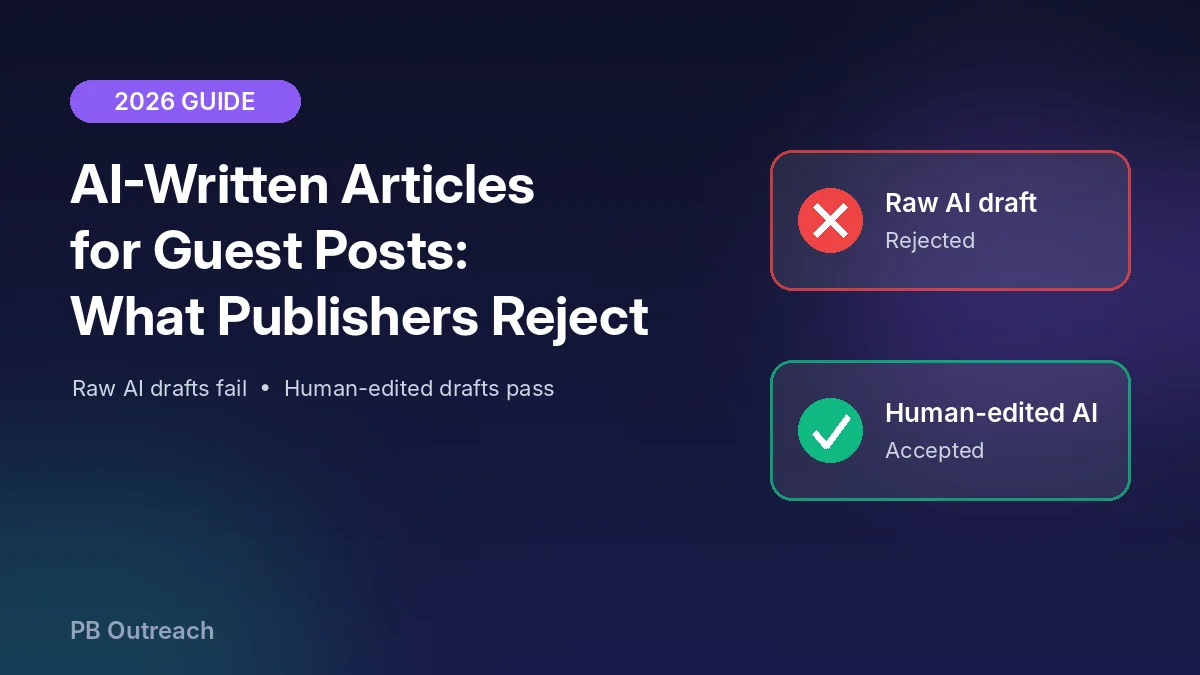
Quick Answer: Raw AI drafts usually fail, while AI-assisted drafts that a human has fact-checked and enriched with original examples usually pass. Real site owners reject unedited AI posts to protect their traffic, since Google's rater guidelines give the Lowest rating to pages made with AI and little to no effort or originality.
Who this guide is for: SEO agencies, link builders and guest post buyers worldwide who use AI writing tools, and the publishers and editors who review their submissions. Prices are in US dollars, the currency most guest post sellers and freelance writers quote in, including those in Pakistan and India. Google's rules on AI content are the same in every country.
The 2026 Reality: Buyers Use AI, Editors Push Back
Buyers use AI because writing is the biggest cost they control. A 1,500-word article from a freelance writer most commonly costs $250 to $399 in 2026, according to BestWriting's survey of 500 writers. An AI draft costs a few cents.
Editors push back because the flood is real. Search Engine Land now states in its editorial guidelines that it no longer accepts submissions from new guest authors, largely because AI-generated content lowered the standard of submissions. In August 2026, Nieman Lab asked opinion editors at 24 US newspapers about AI-written op-eds, and none who replied said they would accept them.
Paid guest post sites are not newspapers, but the same pressure applies. A site owner who publishes weak AI content risks the traffic that makes the site worth buying from.
Also read: AI Content for Blog Traffic: 2026 Guide
Why Real Site Owners Reject Raw AI Guest Posts: 5 Core Reasons
1. Zero Original Data, Examples or Screenshots
Raw AI drafts repeat what is already on page one of Google. They have no client example, no test result and no screenshot. Editors know their readers will learn nothing new, so the post adds nothing to the site.
2. Generic Intros and Obvious AI Vocabulary
Opening lines about "today's digital world" and stock phrases like "in the realm of" or "navigate the landscape" make readers leave. Higher bounce rates on guest posts can drag down how the whole site performs.
3. Hallucinated Statistics and Outdated Facts
Google's own guidance now warns that generative models predict likely words rather than retrieve facts, so outputs can contain errors. A made-up statistic on a publisher's site damages the publisher's reputation, not just the buyer's.
4. Fear of Google Updates
Since January 2025, Google's Search Quality Rater Guidelines tell raters to give the Lowest rating when almost all main content is AI-generated with little effort, originality or added value. Site owners who saw traffic drop after past updates do not want to take that risk for one sale.
5. Anchor Text Stuffed into Robotic Sentences
AI drafts often force an exact-match anchor into a sentence that reads like an ad. Google's link spam policy names keyword-optimized anchors in guest posts as a problem, so careful editors remove them or reject the post.
Raw AI vs Human-Edited AI vs 100% Human Written
Here is how the three approaches compare in 2026. Acceptance and risk levels are typical patterns, not measured rates, because no public study tracks editor decisions across marketplaces.
| Factor | Raw AI draft | Human-edited AI draft | 100% human written |
|---|---|---|---|
| Cost per article (about 1,500 words) | Under $20 (tool subscription) | About $80–$160 (1.5–3 hours of editing at the $53/hour freelance average) | $250–$399 most common (BestWriting 2026) |
| Editor acceptance | Low on sites with real editors | High if facts and examples are added | High |
| Risk of deletion later | High after site audits or traffic drops | Low | Low |
| Ranking and referral value | Weak; few readers click through | Good | Best, especially from expert writers |
| Time to produce | Minutes | 2–4 hours | About a day |
The cheapest option is the most expensive when the post is rejected or deleted, because you lose the placement fee too.
Also read: Guest Post Reseller vs Direct Site Owner: Why $50 Becomes $500
6 Red Flags That Expose an AI Guest Post to Editors
Experienced editors rarely need a detector. These signs give a raw AI draft away within a minute.
- Predictable transitions: Every paragraph starts with "Additionally," "Moreover" or "Furthermore," and every section ends with a tidy summary.
- No links to the host blog: A writer who read the site would link to one or two of its posts. AI drafts never do.
- A generic conclusion: "In conclusion, X is essential for success" tells the editor nobody thought about this specific audience.
- No author voice: No opinions, no "here is what we found," no mistakes learned from. The post could sit on any site.
- Numbers without sources: Round statistics like "73% of marketers" with no link or study name are a common hallucination pattern.
- Wrong format for the site: AI drafts often ignore the host's style, such as heading rules, word count or image requirements.
How to Use AI Safely for Guest Posting: A 4-Step Hybrid Workflow
AI is useful when it does the groundwork and a human does the thinking. Google's own guidance says generative AI can help with research and adding structure to original content.
Step 1: Use AI for the Outline and Research Questions
Ask AI for an outline, likely reader questions and angles competitors miss. Read two or three posts on the host site first, so the outline fits its audience and style.
Step 2: Add What Only a Human Can
Add a real example, a client result, a screenshot or a lesson from your own work. Even one specific story makes the post unique and gives the editor a reason to say yes.
Step 3: Fact-Check Every Number and Claim
Replace every statistic with one you can link to a named source. Google's October 2026 update to its AI guidance says all AI-generated content should be manually fact-checked before publishing.
Step 4: Place the Anchor Naturally and Match the Host's Format
Put your link where it genuinely helps the reader, with a natural or branded anchor. Add one or two links to the host blog, follow its formatting rules and remove stock AI phrases before you submit.
What Google Says About AI Content in Guest Posts
Google does not ban AI content. Its guidance on generative AI content says AI can help with research and structure. It also warns that using AI to generate many pages without adding value for users may violate its scaled content abuse policy.
Three rules matter most for guest posting:
- Scaled content abuse: Mass-producing low-value pages to manipulate rankings is spam, whether a human or AI wrote them.
- Lowest quality rating: Raters are told to give the Lowest rating to pages where almost all main content is AI-generated with little effort, originality or added value.
- Link spam: Google's spam policies treat keyword-rich anchors in guest posts as link spam, and paid links should carry rel="sponsored" or rel="nofollow".
The takeaway is simple. Google judges the result, not the tool. A helpful, accurate, original post is fine however it was drafted.
Also read: Why Google Sends Traffic to Some Pages and Ignores Others (2026)
How We Checked This Guide
Google's position comes from its Search Central guidance on generative AI content (updated October 1, 2026), its spam policies and reporting on the January 2025 Search Quality Rater Guidelines. Writing costs come from BestWriting's January 2026 survey of 500 freelance writers. Editor policies come from Search Engine Land's published editorial guidelines and Nieman Lab's August 2026 survey of newspaper opinion editors.
The comparison table's acceptance and risk levels are typical patterns, not measured rates. The hybrid editing cost is an estimate based on the survey's $53 hourly average.
Disclosure: PB Outreach operates a guest posting marketplace and sells placements, so we have a stake in buyers and publishers working well together. If you want to place guest posts on sites with clear editorial guidelines, you can browse vetted sites on PB Outreach and check each site's requirements and price before you order.
Frequently Asked Questions
Do publishers accept AI guest posts?
Most real publishers reject raw AI drafts but accept AI-assisted posts that a human has edited, fact-checked and enriched with original examples. Some major publications, such as Search Engine Land, have stopped accepting new guest authors largely because of low-quality AI submissions.
Do guest post sites use AI detectors?
Some do, but most experienced editors rely on reading the post. AI detectors are unreliable: OpenAI withdrew its own AI text classifier in 2023 because it correctly flagged only 26% of AI-written text.
Can a publisher delete my guest post later if they realize it's AI?
Yes. Publishers can remove or edit posts at any time, and many clean out thin content after traffic drops or Google updates. Check the site's removal and replacement policy in writing before you pay.
How much does human guest post writing cost in 2026?
BestWriting's 2026 survey of 500 freelance writers found an average of $0.42 per word, and the most common price for a 1,500-word blog post was $250 to $399. Specialist writers in finance, legal or tech charge more.
Does AI content hurt the SEO value of my backlink?
Raw AI content can reduce a backlink's value because thin pages attract few readers and may be removed or rated low quality. A well-edited, original post on a relevant site keeps its value whether or not AI helped draft it.
What are the most common guest post editorial rejection reasons?
The most common reasons are generic content with no original insight, unsourced or wrong statistics, forced exact-match anchor text and a poor fit with the host site's audience. Raw AI drafts often show all four problems at once.
Leave a Reply