

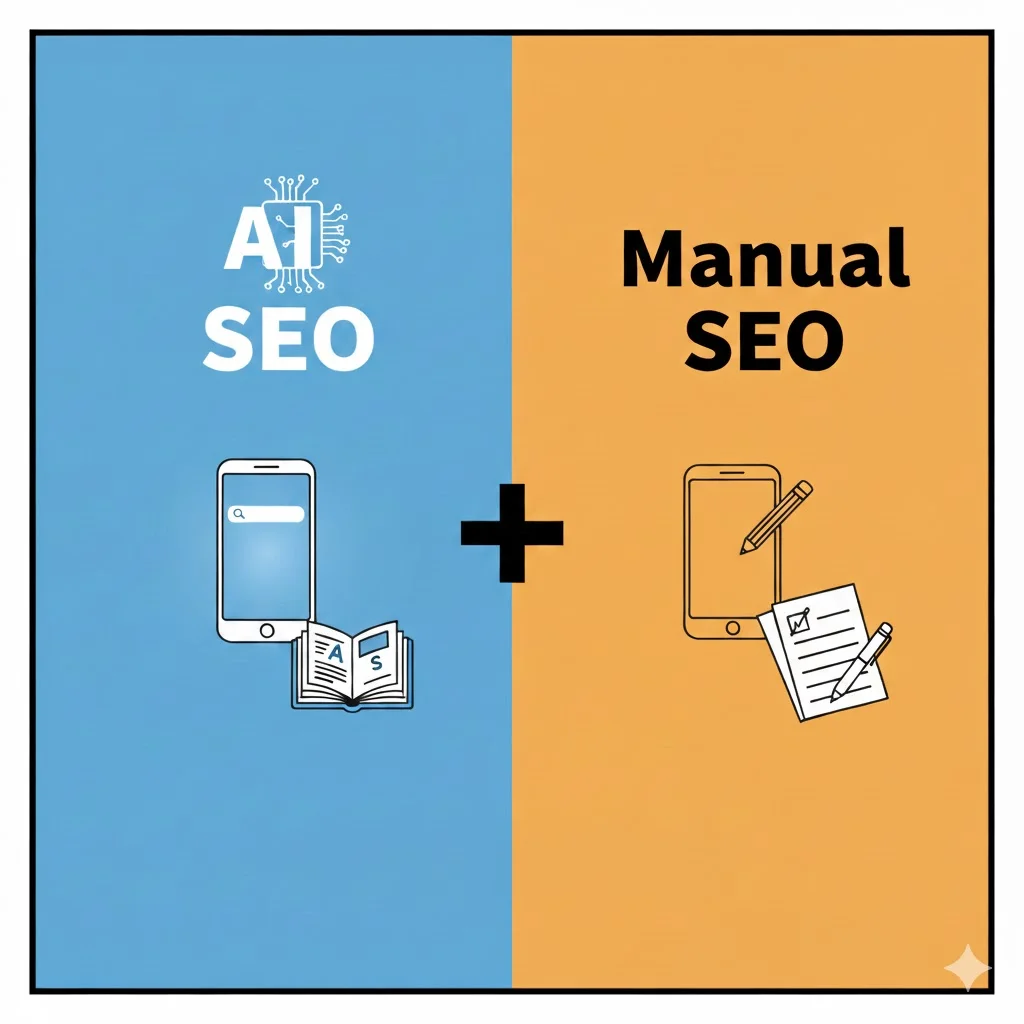
In the field of digital marketing, artificial intelligence has brought about a paradigm shift that is changing how businesses handle search engine optimization. While human expertise and intuition have always been the foundation of classic manual SEO methods, the recently developed AI-driven solutions offer previously unheard-of efficiency and concepts based on empirical data. This essay will address the fundamental distinction between AI search engine optimization and human search engine optimization, and the benefits, limitations, and applications within the modern digital marketing policies.
The most apparent difference between AI and manual SEO is the speed and scalability of processing. With AI, thousands of keywords can be scanned in minutes, websites can be audited, and content suggestions can be made, all in a matter of minutes, whereas this would have taken time-consuming hours or even weeks otherwise. Machine learning models are specifically effective at identifying trends in large volumes of data; therefore, they can enable marketers to unveil prospects of optimization that are not apparent to human analysts (Andayani et al., 2024). This efficiency comes with its own caveats, however.
For repetitive tasks, the AI can make use of being quite clever; however, it lacks the nuances of brand voice and context-dependent industry, which experienced professionals of SEO use during their strategic decisions. SEO practitioners who work manually will take time to familiarize themselves with the purpose of the business, the psychology of the target audience, and the competitive positioning that requires human cognition and overall planning.
The other notable difference is in the quality of the content. The amount of information produced by AI is also tremendous. However, in most instances, they are superficial and generalized, which is increasingly becoming favorable to search engines in an effort to acquire more profound and original content. The slowness of the manual creation of the content allows authentic narration, professional thoughts, and creative views that human readers can identify with and align the purpose of the search to a greater degree (Xie et al., 2024). In addition, cultural peculiarities, humor, or emotional intelligence, which become a significant portion of interesting content that makes users actually engaged, are challenging to explain to AI. Human SEO professionals can generate engaging stories, build genuine backlinks through relationship-building, and switch strategies based on their intuitive understanding of market dynamics that AI cannot emulate.
The future of SEO is not whether there will be the possibility of AI or manual, but rather the suitable answer of integrating the two strategies. AI is more effective at analyzing the information and automation and identifying the opportunities for technical optimization, but human abilities cannot be replaced in terms of planning the strategies, creating the content creatively, and creating the actual relationships. The companies that will be most efficient due to the efficacy of AI and human ingenuity and intuition will be those that will get the most sustainable and efficient SEO results in an environment that becomes more competitive in the digital domain.
Leave a Reply